


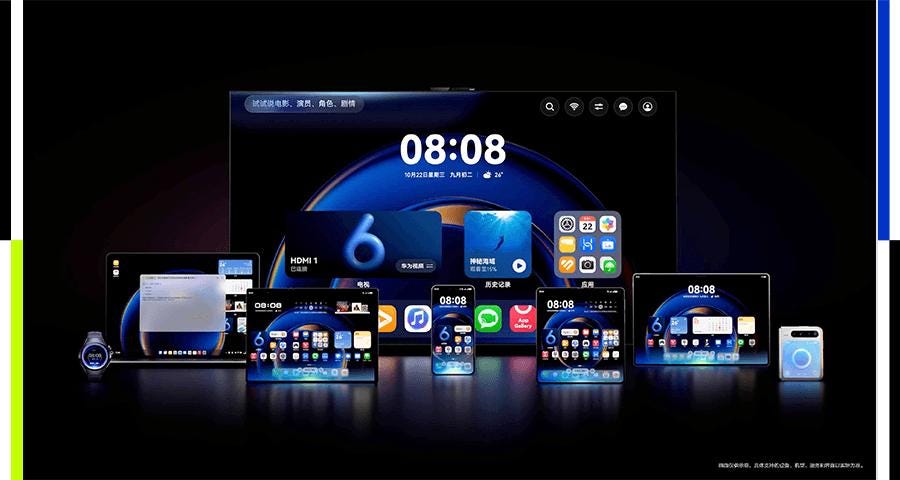
Let’s talk about the conclusion first: By this point in 2026, software manufacturers will be interested in the HarmonyOS system (especially HarmonyOS NEXT+/HarmonyOS 6 +The enthusiasm for adaptation has completely shifted from the early wait-and-see to the full speed sprint.
To put it simply, the current HarmonyOS adaptation is no longer a “plus” for manufacturers, but has become a “must-have option”. No one can ignore the hundreds of millions of devices, and the ecosystem of HarmonyOS native applications has crossed the key “life and death line”.
--Now 5kw, estimated to exceed 100 million at the end of the year, not bragging, but the actual situation, Huawei’s mobile phone equipment in 2026 is estimated to return to the king, and several friends in the mobile phone industry are under some pressure. In other words: as an ordinary cattle and horses, one more ecology will not lead to more social employment opportunities, which is definitely good for our cattle and horses, especially the Internet industry.
Comprehensive coverage of core applications: The main apps of leading Internet
manufacturers (such as Tencent, Alibaba, ByteDance, Meituan, etc.) have already completed native adaptation. Applications with 100 million daily active users such as WeChat, Alipay, Douyin, and Xiaohongshu have the same experience as Android/iOS versions, and even have advantages in distributed collaboration (such as cross-device circulation).
Explosion in the number of native applications: As of early 2026, the number of HarmonyOS native applications and cloud services has exceeded 75,000.
Overseas manufacturers take the initiative to enter the game: It is particularly noteworthy that international brands such as Tesla have also taken the initiative to launch native HarmonyOS versions, which marks the recognition of the value of the HarmonyOS ecosystem in the eyes of global developers.
The change in manufacturers’ attitudes is mainly due to the following three driving forces:
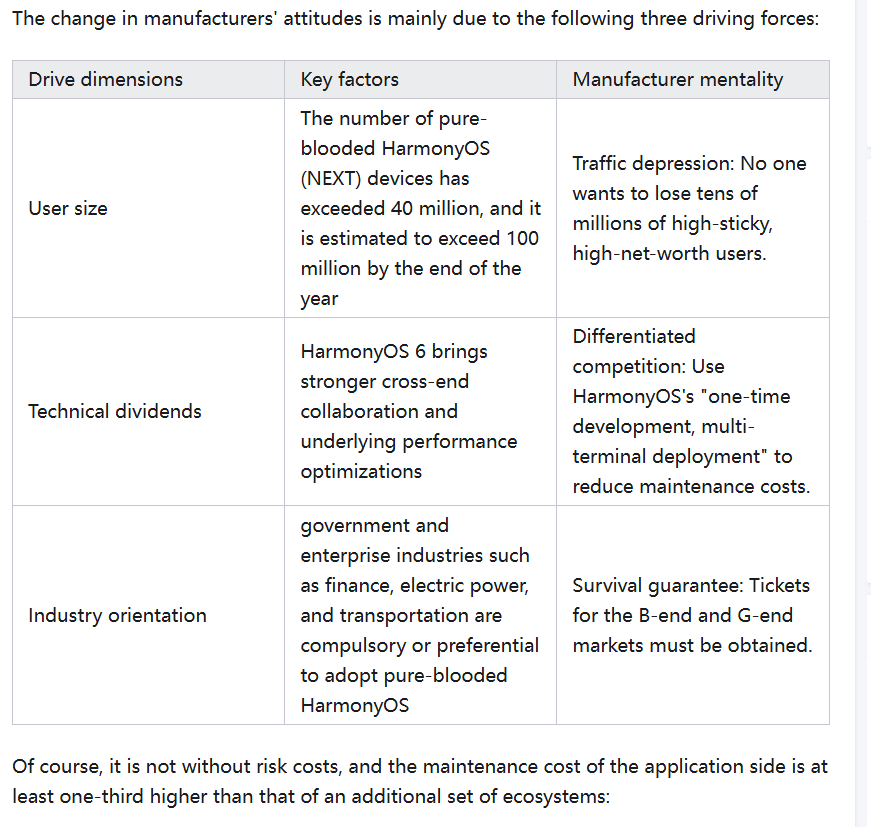
Of course, it is not without risk costs, and the maintenance cost of the application side is at least one-third higher than that of an additional set of ecosystems:
The cost of overturning and starting over: HarmonyOS NEXT has been completely
stripped away AOSP+(Android open source project), which means that manufacturers can no longer use Android code to “shell”, they must use it ArkTS+ language and ArkUI + Frameworks rewrite application logic. For large apps with heavy technical debt, this is tantamount to “tearing down and rebuilding”.
Talent premium: In 2024-2025, HarmonyOS development talents were in short supply, resulting in a surge in R&D investment costs in the early stage of adaptation.
Performance tuning: Unlike Android, manufacturers need to spend a lot of energy to deeply optimize the HarmonyOS base to achieve Huawei’s claimed “fluency improvement”.
4. Conclusion and insight
The current situation is: large factories are rolling performance, and small factories are catching up with the progress.
If two years ago, adapting to HarmonyOS still needed Huawei to “seek” manufacturers, then the current situation in 2026 is that manufacturers are queuing up to squeeze into Huawei’s developer support plan. For Internet veterans like you, HarmonyOS is no longer an “alternative system”, but a new growth pole with independent distribution logic and independent technology stack.
Source: Are software manufacturers highly motivated to adapt to the HarmonyOS system? - Did you know?